
Overview
A manufacturing operation relied on Precision Service Machine Tool Rebuilders to repair the bed and machine base of an engine lathe that required expert attention before the machine could move forward in the rebuild process. Because the bed is the foundation of lathe accuracy, any wear, damage, or surface irregularity can affect carriage travel, turning consistency, part quality, and long-term machine performance.
Our team evaluated the machine bed, identified the areas that needed repair, and performed the necessary correction work to restore a more dependable foundation for the lathe. This project gave the customer a clear path forward, helping determine the next steps required for the machine base and overall rebuild.
Rather than treating the machine as a simple part replacement job, Precision Service Machine Tool Rebuilders approached the project as a precision repair that required careful inspection, experienced judgment, and attention to the machine’s future alignment needs.
Project Background & Objectives
Engine lathes depend on a stable, accurate bed to guide the carriage and support consistent turning operations. When the bed or machine base is worn or damaged, the machine may begin to show issues such as:
For this project, the customer needed Precision Service Machine Tool Rebuilders to address the lathe bed before additional work could be properly planned. The main objectives were to:
Our Rebuild Process
- Initial Inspection & Repair Planning
- Bed Surface Preparation
- Engine Lathe Bed Repair
- Machine Base Evaluation
- Alignment & Next-Step Planning
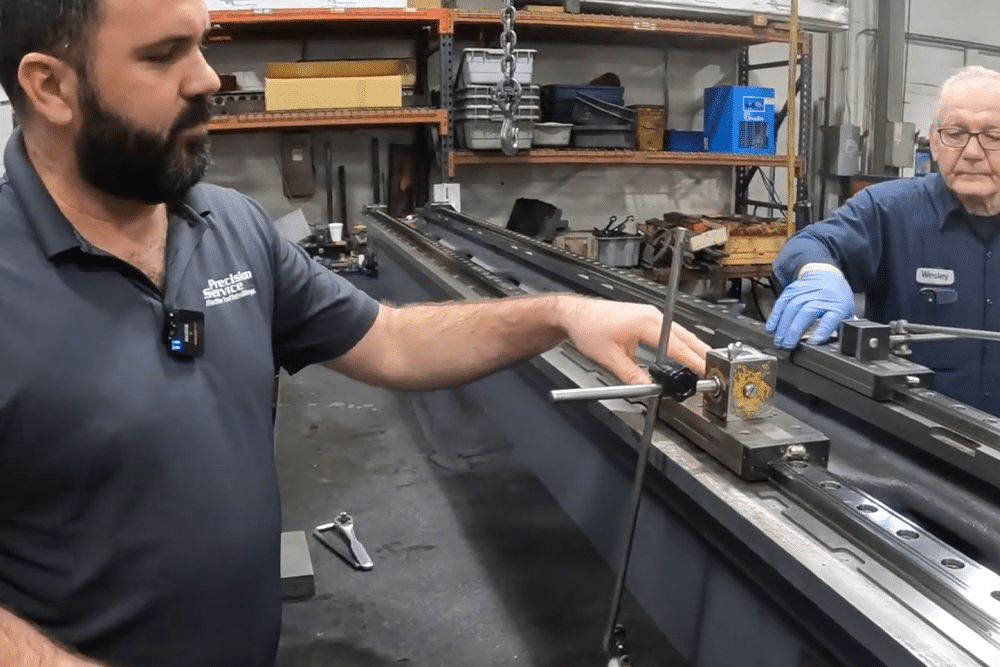
Precision Service Machine Tool Rebuilders began by reviewing the condition of the lathe bed and identifying the areas that required correction. On an engine lathe, the bed is one of the most important structural components because it directly influences how the carriage travels along the length of the machine.
Our inspection focused on understanding the condition of the bed surface, the surrounding machine base, and the repair work needed to prepare the lathe for the next stage of service. This allowed our team to determine the best approach before moving into corrective work.
Before any precision repair work could be completed, the affected surfaces needed to be properly prepared. This included cleaning and evaluating the bed so that damage, wear patterns, and surface irregularities could be clearly identified.
Proper preparation is a critical part of machine tool repair. It helps ensure that the repair process is based on the actual condition of the machine, not assumptions. This is especially important on lathe beds, where small surface issues can influence the overall geometry and performance of the machine.
Once the problem areas were identified, our team performed the necessary repair work to improve the condition of the lathe bed. This type of work requires careful control because the bed must remain consistent, stable, and properly referenced for future alignment.
The repair process focused on restoring the bed as a functional foundation for the machine. Rather than simply addressing visible damage, Precision Service Machine Tool Rebuilders considered how the repaired bed would support future carriage travel, machine alignment, and operational reliability.
After the lathe bed repair was completed, the machine base was reviewed to determine the appropriate next steps. This stage is important because the bed and base work together as part of the machine’s overall structure.
A repaired bed can only perform properly if the machine base is also stable and suitable for continued rebuilding or alignment work. By evaluating the base after the bed repair, our team helped the customer better understand what additional work may be needed before the lathe returns to full service.
Precision Service Machine Tool Rebuilders also provided value by helping define the next stage of the project. For many machine rebuilds, the repair process must be completed in the right sequence. Bed repair comes early because it affects everything that follows, including carriage fit, tailstock alignment, headstock relationship, and final machine geometry.
By addressing the bed first, our team helped create a more accurate foundation for future repair or rebuild work.
Value Delivered by PSMTR
Project Outcome
The engine lathe bed repair gave the customer a stronger foundation for the next stage of the machine’s rebuild. By addressing the bed first, Precision Service Machine Tool Rebuilders helped prepare the machine for additional evaluation, alignment, and base-related repair planning.
The project demonstrated the importance of approaching machine repair in the correct order. When the bed is repaired properly, the rest of the machine has a better foundation for accurate movement, alignment, and long-term performance.
Conclusion
This engine lathe bed repair project highlights the value of working with an experienced machine tool rebuilder when accuracy begins to decline or structural machine components need attention. Precision Service Machine Tool Rebuilders provided the inspection, repair expertise, and practical guidance needed to move the project forward with confidence.
For manufacturers dealing with worn lathe beds, machine base concerns, carriage movement issues, or declining turning accuracy, professional repair can be a smart alternative to premature replacement. By restoring the machine’s foundation, PSMTR helps customers protect their equipment investment and extend the useful life of critical machine tools.
Disclaimer
This case study is provided for informational purposes only. Machine condition, repair requirements, operating environment, and performance outcomes vary by project. Actual results may differ. Always consult qualified machine tool rebuilding professionals before making equipment repair or replacement decisions.