
Overview
A customer brought Precision Service Machine Tool Rebuilders into a vertical turning lathe project that required detailed inspection of the machine’s RAM. While the RAM may have appeared serviceable at first glance, a precision flatness check revealed hidden damage that could have affected machine accuracy, tool positioning, surface finish, and long-term reliability.
Because the RAM is a critical moving component on a VTL, any unevenness, damage, wear, or distortion can directly impact cutting performance. Our team performed a careful flatness inspection to identify the true condition of the RAM surface and determine what corrective work would be needed before the machine could be confidently returned to service.
This project demonstrated the value of thorough inspection during the rebuild process. Rather than assuming the machine’s major components were acceptable, Precision Service Machine Tool Rebuilders verified the condition of the RAM and uncovered issues that may have gone undetected until they caused performance problems in production.
Project Background & Objectives
Vertical turning lathes depend on accurate RAM movement to maintain proper tool position, cutting geometry, and repeatable machining results. When the RAM surface is worn, damaged, or out of flatness, the machine may experience issues such as:
- Inconsistent cutting performance
- Loss of squareness or parallelism
- Tool positioning errors
- Poor surface finish
- Difficulty holding tolerances
- Uneven load distribution on sliding surfaces
- Accelerated wear on mating components
- Long-term alignment problems
For this project, the customer needed a clear understanding of the RAM’s condition as part of the larger repair and rebuild evaluation. The main objectives were to:
- Inspect the VTL RAM for flatness and surface condition
- Identify hidden damage that could affect machine performance
- Determine whether the RAM required additional repair
- Protect the customer from returning a compromised component to service
- Support the accuracy and reliability of the overall machine rebuild
Rebuild Process
- Initial RAM Inspection
- Precision Flatness Check
- Identifying Hidden Damage
- Repair Planning & Corrective Recommendations
- Supporting the Larger VTL Rebuild
Precision Service Machine Tool Rebuilders began by evaluating the RAM and preparing it for a more detailed flatness check. On a vertical turning lathe, the RAM plays a direct role in tool movement and cutting accuracy, so its condition must be verified before final alignment or reassembly work can be completed.
Our inspection focused on identifying visible wear, surface irregularities, and any signs that the RAM may have experienced impact, distortion, or uneven contact during operation.
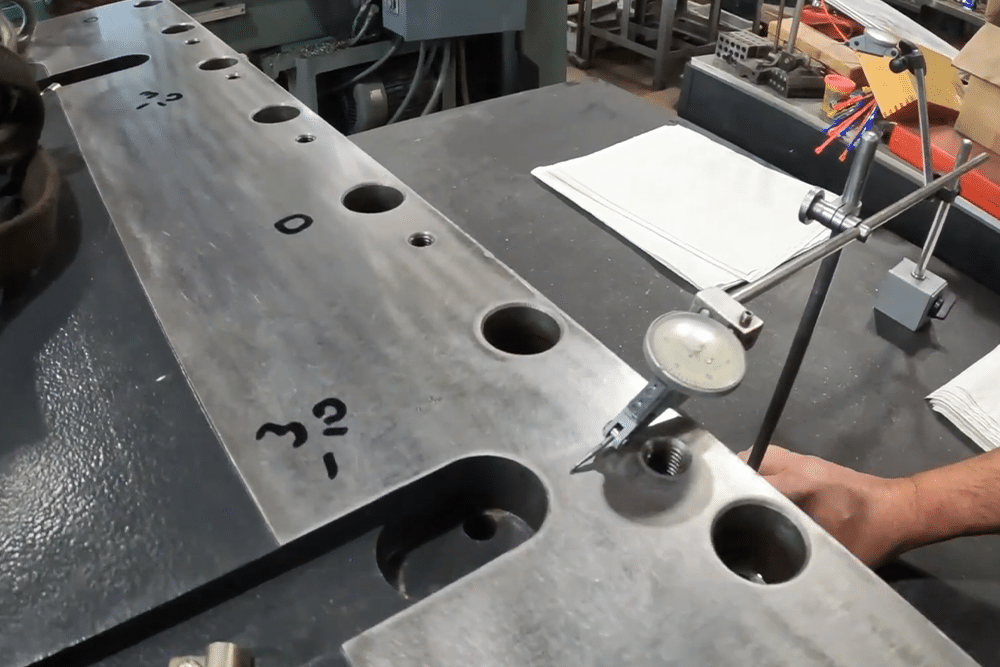
After the initial review, our team performed a flatness check to determine the true condition of the RAM surface. This step is important because hidden damage is not always obvious during a basic visual inspection.
A RAM may appear usable until it is checked against a precision reference. Once measured properly, low spots, high spots, gouging, distortion, or uneven surface contact can become clear. These findings help determine whether the component can be reused as-is or if corrective machining, grinding, scraping, or additional repair work is required.
During the flatness inspection, damage was revealed that could have created problems if the RAM had been reinstalled without correction. Hidden surface issues on a VTL RAM can affect how the component travels, how it contacts its mating surfaces, and how accurately the cutting tool is positioned during operation.
By finding this damage during inspection, Precision Service Machine Tool Rebuilders helped prevent the customer from moving forward with a machine component that could have compromised the entire rebuild.
Once the damage was identified, our team reviewed the condition of the RAM and considered the appropriate repair path. The goal was not simply to note that damage existed, but to help determine what needed to happen next to restore dependable machine performance.
This type of inspection allows the customer to make informed decisions before additional rebuild work continues. It also helps ensure that any corrective work is completed in the proper sequence, reducing the risk of alignment issues later in the project.
A VTL rebuild depends on each major component being inspected and corrected before final assembly and alignment. The RAM is especially important because it influences the relationship between the tool, the workpiece, and the machine’s vertical movement.
By checking the RAM before moving further into the rebuild process, PSMTR helped protect the integrity of the overall project. Addressing this type of damage early supports more accurate machine geometry, improved cutting performance, and better long-term reliability.
Value Delivered by PSMTR
Project Outcome
The VTL RAM flatness check revealed hidden damage that needed to be addressed before the machine could move forward with confidence. By identifying the issue during inspection, Precision Service Machine Tool Rebuilders helped the customer avoid future accuracy problems and better understand the true condition of the machine.
The project reinforced the importance of precision inspection as part of the rebuild process. When critical components are checked properly, hidden problems can be found early, repair decisions can be made with better information, and the finished machine has a stronger foundation for long-term performance.
Conclusion
This VTL RAM inspection project demonstrates why thorough evaluation is critical during machine tool repair and rebuilding. Hidden damage on a RAM can affect machine accuracy, tool positioning, and cutting consistency, even if the issue is not immediately visible.
Precision Service Machine Tool Rebuilders provided the inspection expertise, machine knowledge, and practical repair guidance needed to identify the problem and support the next stage of the rebuild. For manufacturers dealing with VTL accuracy issues, worn sliding surfaces, or unknown machine damage, a detailed flatness check can be the difference between a temporary repair and a dependable restoration.
Disclaimer
This case study is provided for informational purposes only. Machine condition, repair requirements, operating environment, and performance outcomes vary by project. Actual results may differ. Always consult qualified machine tool rebuilding professionals before making equipment repair or replacement decisions.