
Overview
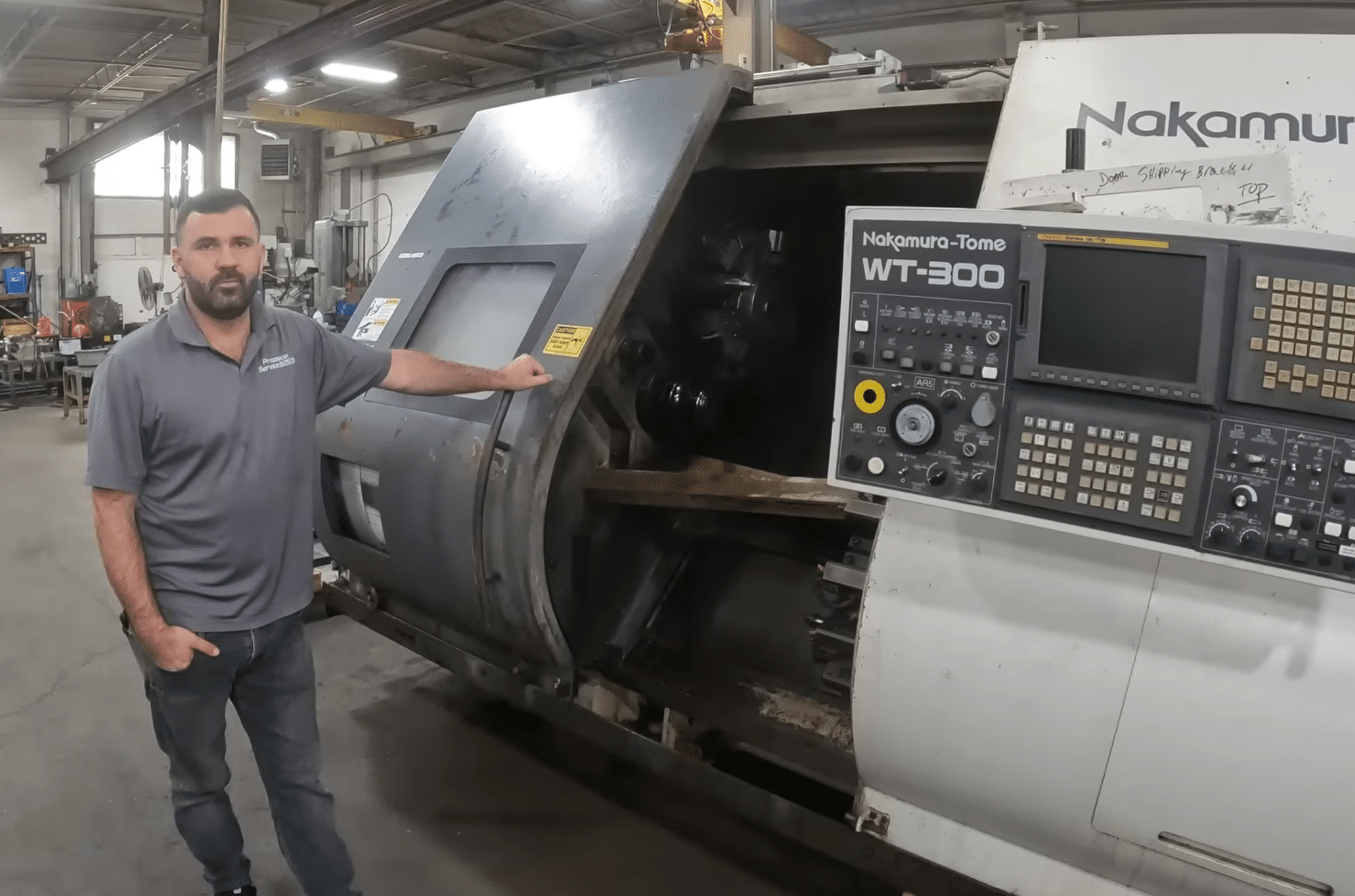
A manufacturing customer operating a Nakamura-Tome WT-300 twin-spindle turning center partnered with PSMTR for a full mechanical and CNC rebuild to restore performance, reduce downtime, and extend machine life. Years of heavy production use had led to declining accuracy, worn mechanical components, lubrication issues, and diminishing control reliability. Rather than invest in a new machine—with its high capital cost and long lead times—the customer chose a comprehensive rebuild.
PSMTR delivered complete disassembly, precision measurement, component replacement, way-surface restoration, lubrication renewal, control-system updates, and final alignment/testing. The WT-300 returned to near-factory performance with improved uptime, extended service life, and high repeatability.
Project Background & Objectives
The WT-300 played a critical role in the customer’s production environment, supporting continuous multi-axis machining operations across two synchronized spindles. Over years of operation, the machine experienced:
Replacing a twin-spindle turn-mill center would require a major capital expenditure and significant installation downtime. A rebuild offered the ability to:
PSMTR’s mechanical, scraping, grinding, and CNC expertise made them the ideal partner for a multi-axis machine of this complexity.
Our Rebuild Process
- Full Disassembly & Condition Assessment
- Cleaning, Preparation & Surface Restoration
- Replacement of Worn Components & Sub-Assembly Rebuild
- Way-Surface Grinding & Hand Scraping
- Control/Servo System Refresh & Re-Integration
- Final Alignment, Testing & Certification
The project began with a complete teardown of the WT-300. PSMTR removed all guarding, covers, and sheet metal to expose the mechanical and electrical systems. The team extracted spindles, ball screws, linear guides, servo assemblies, lubrication components, and electrical hardware for inspection.
During the assessment, PSMTR measured geometric deviations, evaluated mechanical wear patterns, documented lubrication issues, and created a component-level rebuild plan. This early-phase evaluation determined which parts required replacement versus reconditioning.
All machine components underwent thorough cleaning, degreasing, rust removal, and surface preparation.
PSMTR cleaned and verified:
- Structural casting surfaces
- Mounting faces and alignment reference points
- Oil ports, channels, and lubrication passages
- Ball-screw housings and guide-way supports
This preparation ensured accurate fixturing and reliable reference geometry prior to grinding, scraping, and reassembly.
Following inspection, PSMTR replaced several major wear items:
- New ball screws for critical axes
- Refurbished or replaced spindle bearings as needed
- Renewed linear guides and support assemblies
- Rebuilt lubrication system components
- Refurbished or replaced servo motors, encoders, and drive components
Sub-assemblies were re-machined, cleaned, and validated before installation. PSMTR ensured proper preload, bearing adjustment, and axial alignment across all moving elements.
Because the WT-300 exhibited significant guide-surface wear, PSMTR performed precision way-surface grinding to re-establish:
- Flatness
- Straightness
- Parallelism between mating surfaces
- Proper geometry for the machine’s sliding structures
After grinding, extensive hand scraping refined the bearing surfaces. This stage achieved:
- Proper bearing contact percentage
- Even load distribution
- Correct oil-retention patterns
- Smooth, low-friction travel across full stroke
These manual craftsmanship steps ensure long-term geometric stability and smooth motion.
Once mechanical components were restored, PSMTR turned attention to the CNC and servo systems. This included:
- Cleaning, refurbishing, or replacing control modules
- Servo tuning
- Encoder verification
- Cable management and harness replacement where needed
- Reinstallation of spindles, ball screws, and linear axes
- Functional benchmarking of axis movement
The control system was recalibrated after reassembly to ensure proper feedback response, minimal drift, and synchronized spindle operation.
The machine was reassembled with precise geometric alignment of:
- Twin spindles
- X-, Y-, and Z-axis travel
- Sub-spindle hand-off alignment
- Tooling interfaces and turret positioning
PSMTR conducted a rigorous series of tests, including:
- Dynamic axis motion tests
- Rapid-move verification
- Backlash and repeatability checks
- Thermal stabilization runs
- Trial cutting and performance verification
Upon completion, the machine demonstrated smooth travel, stable accuracy, improved cycle consistency, and restored production capability.
Value Delivered by PSMTR
Conclusion
The rebuild of the Nakamura-Tome WT-300 shows how a well-executed machine-tool restoration can offer exceptional return on investment. By restoring geometry, renewing critical wear components, rebuilding lubrication systems, and refreshing controls, PSMTR returned a heavily used machine to dependable, production-ready condition.
For manufacturers facing accuracy loss, mechanical wear, or reliability challenges in their CNC equipment, a professional rebuild remains a powerful and cost-effective option that preserves capital while extending machine life.
Disclaimer
This case study is provided for informational purposes only. Every machine’s condition, application, and operating environment is unique. Actual results may vary. Always consult qualified professionals before making equipment decisions. To learn more about this project, view a breakdown on our YouTube Channel.