
Overview
A mid-volume industrial manufacturer partnered with Precision Service Machine Tool Rebuilders (PSMTR) to restore a legacy high-precision cylindrical grinding machine whose accuracy, uptime, and reliability had degraded after years of intensive use. PSMTR executed a comprehensive mechanical, electrical, and geometric rebuild—returning the machine to near-new performance and extending its service life at a fraction of replacement cost. For professionals evaluating whether to repair or replace aging equipment, this project highlights the measurable value that a full, engineering-driven rebuild can provide.
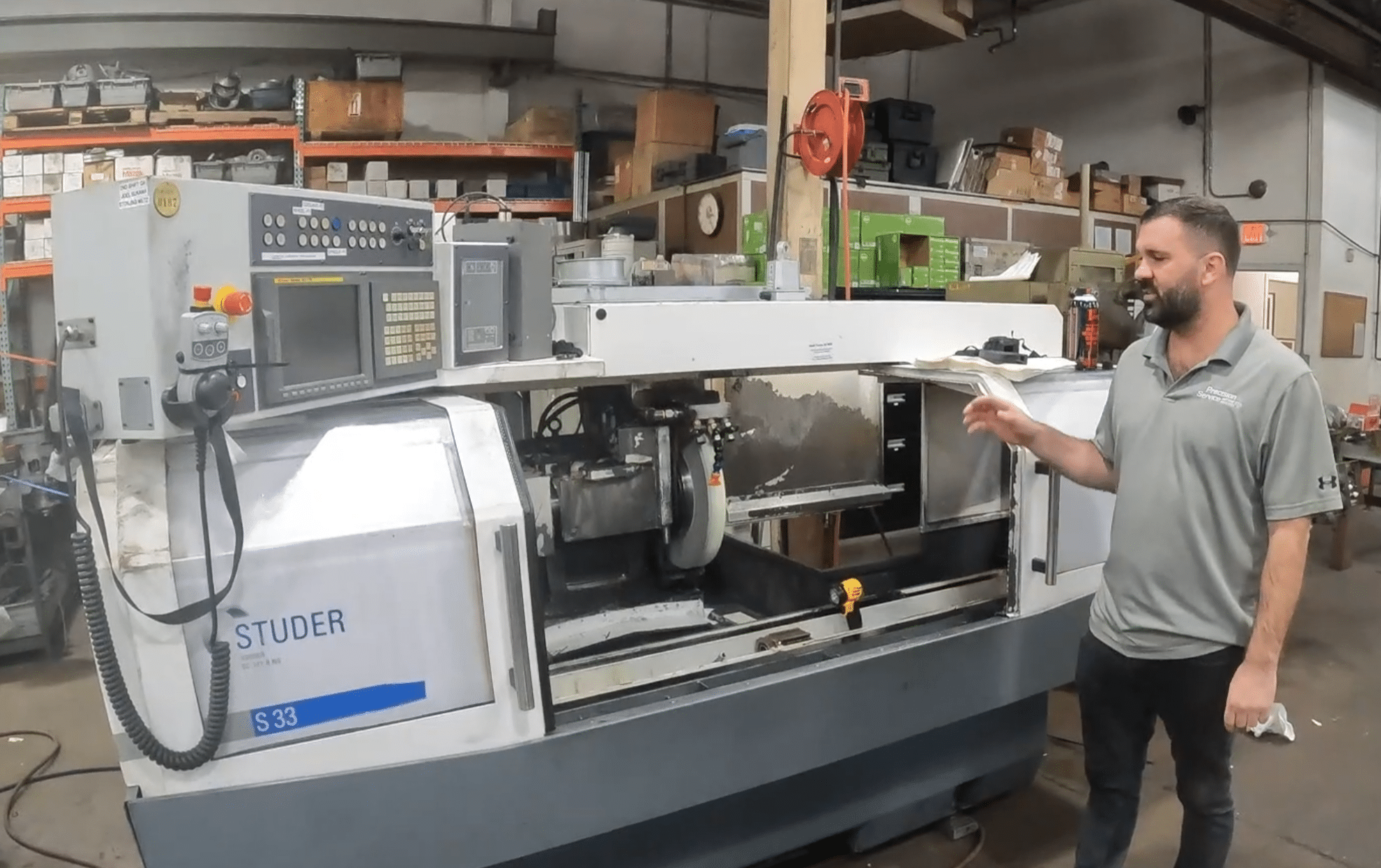
Project Background & Objectives
The manufacturer relied heavily on this precision grinder to produce tight-tolerance tooling and production components. Over time, wear, thermal drift, outdated controls, and mechanical instability caused:
A full machine replacement would require significant capital investment, integration time, and operator retraining. The company instead chose to rebuild the machine with the following goals:
PSMTR was selected due to their proven mechanical, electrical, and precision-alignment expertise in rebuilding complex cylindrical grinding platforms.
Rebuild Process
- Full Disassembly & Assessment
- Cleaning, Surface Prep & Mechanical Evaluation
- Precision Way-Grinding & Geometry Reconstruction
- Spindle Rebuild & Performance Restoration
- Electrical System & Control Modernization
- Reassembly, Alignment & Performance Verification
- On-Site Commissioning & Documentation
The grinder was completely stripped down—covers, electrical enclosures, motion assemblies, hydraulic lines, spindle components, and table systems were all removed. Each subsystem was cleaned, cataloged, and inspected. Wear patterns were identified on critical ways, spindle assemblies, and bearing housings.
All castings and components were cleaned, degreased, and prepared for rebuild. Hydraulic and pneumatic systems were disassembled and tested. Castings were checked for straightness, stress, and structural integrity.
Significant wear was present on the machine’s longitudinal and cross-axis ways. PSMTR reground and lapped these surfaces to restore:
- Flatness
- Parallelism
- Straightness
- Axis squareness
Guideways, scraped surfaces, and bearing pads were rebuilt or replaced. Head-slide surfaces and the spindle-carriage geometry were fully restored.
The spindle assembly was disassembled and evaluated. Worn bearings were replaced, preload settings were re-established, and the entire spindle was balanced and tested. Excess run-out and vibration levels were eliminated, producing the stable, repeatable rotation required for high-precision grinding.
The outdated electrical system was replaced with new PLCs, updated servo drives, modern HMI controls, and entirely new wiring looms. This eliminated serviceability issues, improved diagnostics, and enhanced operator usability. Coolant and hydraulic system controls were also updated for better reliability.
Following reassembly, PSMTR executed comprehensive alignment procedures:
- Spindle-to-table alignment
- Axis parallelism and squareness
- Machine leveling and thermal checks
- Straightness and positioning accuracy
Verification grinding tests were performed using reference components to confirm dimensional repeatability, surface finish, and stability across the machine’s operating envelope.
Upon delivery back to the customer, the grinder was leveled, connected, and fully commissioned. Operators received support on first-run parts, and the customer was provided:
- Geometric inspection reports
- Spindle test data
- Updated wiring diagrams
- Maintenance schedules and service recommendations
Value Delivered by PSMTR
Conclusion
This project demonstrates the strategic and financial value of rebuilding a high-precision grinding asset rather than replacing it. PSMTR restored the machine’s mechanical integrity, updated its electrical and control systems, re-established critical geometry, and delivered a thoroughly documented result—ultimately helping the manufacturer regain precision, improve reliability, and extend equipment lifecycle.
For operations facing degraded performance, obsolete controls, or increasing downtime on their grinding equipment, a professionally executed rebuild from a specialized machine-tool rebuilder can deliver exceptional ROI and long-term confidence in an essential production asset.
Disclaimer
This case study is provided for informational purposes only. The specific results achieved in this rebuild may not be indicative of what you will obtain. Each machine condition, application, and operating environment is unique; you should engage qualified service providers and conduct your own evaluation before making decisions.
To learn more about this project, view a breakdown on our YouTube Channel.