
Overview
A manufacturer operating a large-capacity horizontal turning lathe began experiencing significant wear across the machine’s carriage, headstock assembly, and feed system. Accuracy drift, vibration, lubrication failures, and progressive loss of rigidity were limiting the machine’s ability to hold tolerances and produce consistent finishes. Instead of purchasing a new large-format turning lathe—an investment that would require long lead times and substantial capital—the customer contracted Precision Service Machine Tool Rebuilders (PSMTR) for a complete mechanical and geometric restoration.
PSMTR delivered a full teardown, bed and carriage rework, precision alignment, spindle-system rebuilding, extensive hand scraping, lubrication-system renewal, and final operational validation. The rebuilt lathe returned to production with dramatically smoother motion, restored rigidity, renewed accuracy, and an extended service life—all at a fraction of replacement cost.
Project Background & Objectives
This project involved a heavy-duty CNC turning lathe known for long-travel capability and high-horsepower roughing. Years of continual use led to a range of mechanical issues, including:
These issues collectively created downtime, scrap, and overall loss of confidence in the machine. Because replacing a lathe of this size involves multi-month wait times and six-figure capital expense, a rebuild offered a faster, more economical alternative.
Primary project goals included:
PSMTR was selected due to our deep expertise in long-way scraping, precision alignment, and full-machine mechanical overhauls.
Our Rebuild Process
- Complete Disassembly & Mechanical Evaluation
- Cleaning, Degreasing & Surface Preparation
- Bedway Grinding & Geometry Restoration
- Extensive Hand Scraping for Accuracy, Load Distribution & Oil Retention
- Headstock & Spindle Restoration
- Cross-Slide, Gibs & Feed-System Renewal
- Lubrication-System Rebuild
- Final Fit-Up, Alignment & Performance Verification
PSMTR began by fully disassembling the lathe, including removal of:
- Carriage, saddle, and cross-slide
- Headstock and spindle assembly
- Tailstock and quill components
- All lubrication hardware and metering units
- Wipers, covers, and guarding
A comprehensive inspection identified:
- Scoring and galling on bedways
- Wear taper along the carriage travel
- Degraded oil-film behavior
- Play in the cross-slide and compound assembly
- Contamination inside the headstock and lubrication system
This stage established a precise corrective plan.
All major castings and precision surfaces underwent:
- Complete degreasing and stripping of aged lubricants
- Cleaning of oil passages, way covers, and ports
- Removal of rust, swarf, and embedded debris
- Preparation for grinding and scraping operations
A contamination-free foundation was essential for restoring geometry.
Using large-format precision grinding equipment, PSMTR restored:
- The bed’s primary bearing surfaces
- Parallelism between front and rear ways
- Straightness and flatness along full travel
- Correct alignment for carriage and headstock relationship
This machining phase removed wear tracks, corrected drift, and re-established true geometry ahead of final scraping.
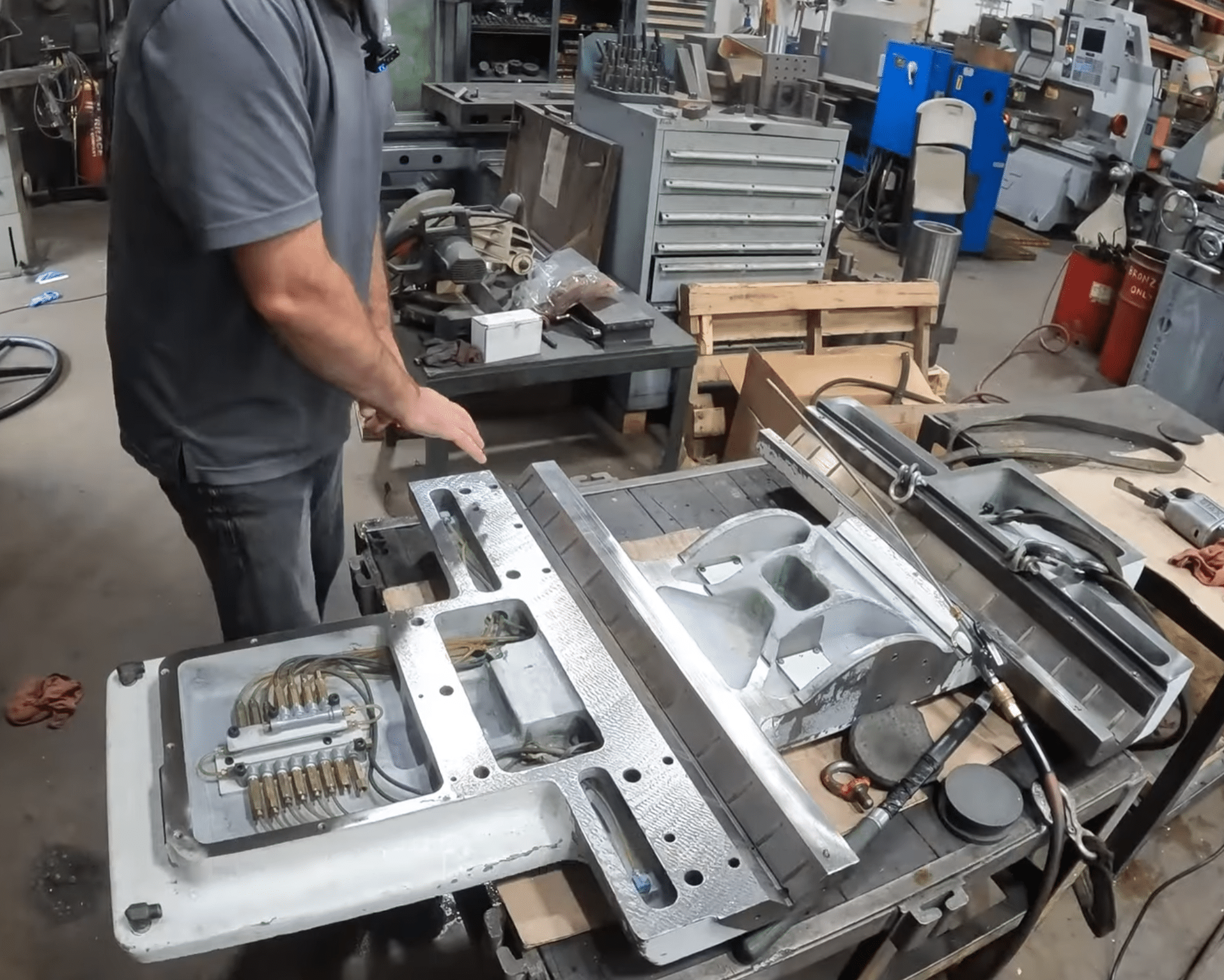
Hand scraping was a major component of this rebuild, including:
- Bringing the carriage into proper bearing contact across full stroke
- Establishing balanced load distribution to prevent future uneven wear
- Creating oil-retention pockets with consistent cross-hatch patterns
- Refining parallelism and squareness between axes
This step delivered the smooth, predictable movement required for both heavy roughing and fine finishing.
The rebuild included substantial headstock work:
- Complete disassembly and cleaning
- Bearing-journal inspection and correction
- Installation of new precision spindle bearings
- Reconditioning of sealing surfaces and lubrication flow
- Verification of thermal behavior and preload
PSMTR ensured spindle performance returned to high-precision, smooth-running condition.
The carriage and cross-slide were re-established to factory-spec alignment:
- Regrinding of mating surfaces where required
- Scraping to restore fit, accuracy, and travel smoothness
- Replacement of gibs, wipers, and wear components
- Correction of backlash in feed screws and nuts
- Alignment checks for perpendicularity and tool-point accuracy
This restored rigidity and eliminated lost motion.
PSMTR rebuilt the lubrication system to ensure long-term reliability:
- Cleaning and clearing all oil galleries
- Installing new metering units, lines, and fittings
- Restoring correct oil-delivery patterns across the ways
- Replacing seals and wipers to prevent contamination
Proper lubrication is essential for long way surfaces on large turning machines, and this step dramatically improved wear resistance going forward.
After mechanical restoration, PSMTR completed a rigorous alignment and testing sequence:
- Verification of straightness, flatness, and parallelism
- Headstock-to-bed alignment checks
- Tailstock quill alignment and fitment
- Push/pull effort measurements along the carriage
- Backlash and repeatability testing
- Actual cutting tests under load
The final machine demonstrated excellent motion quality, strong rigidity, and restored precision across its full capacity.
Value Delivered by PSMTR
Conclusion
This rebuild demonstrates the strong value of fully restoring a worn heavy-duty horizontal turning lathe rather than replacing it. Precision Service Machine Tool Rebuilders returned the machine to near factory-level performance through detailed mechanical restoration, precision way correction, spindle rebuilding, and complete alignment verification.
For shops experiencing accuracy loss, inconsistent finishes, lubrication failures, or rigidity issues on large turning machines, a professional rebuild offers exceptional return on investment—delivering renewed precision, reliability, and productivity without the cost and delays of new equipment.
Disclaimer
This case study is for informational purposes only. Machine condition, operating environment, and rebuild scope vary. Actual results may differ. Always consult qualified professionals when evaluating repair or rebuild options.To learn more about this project, view a breakdown on our YouTube Channel.