
Overview
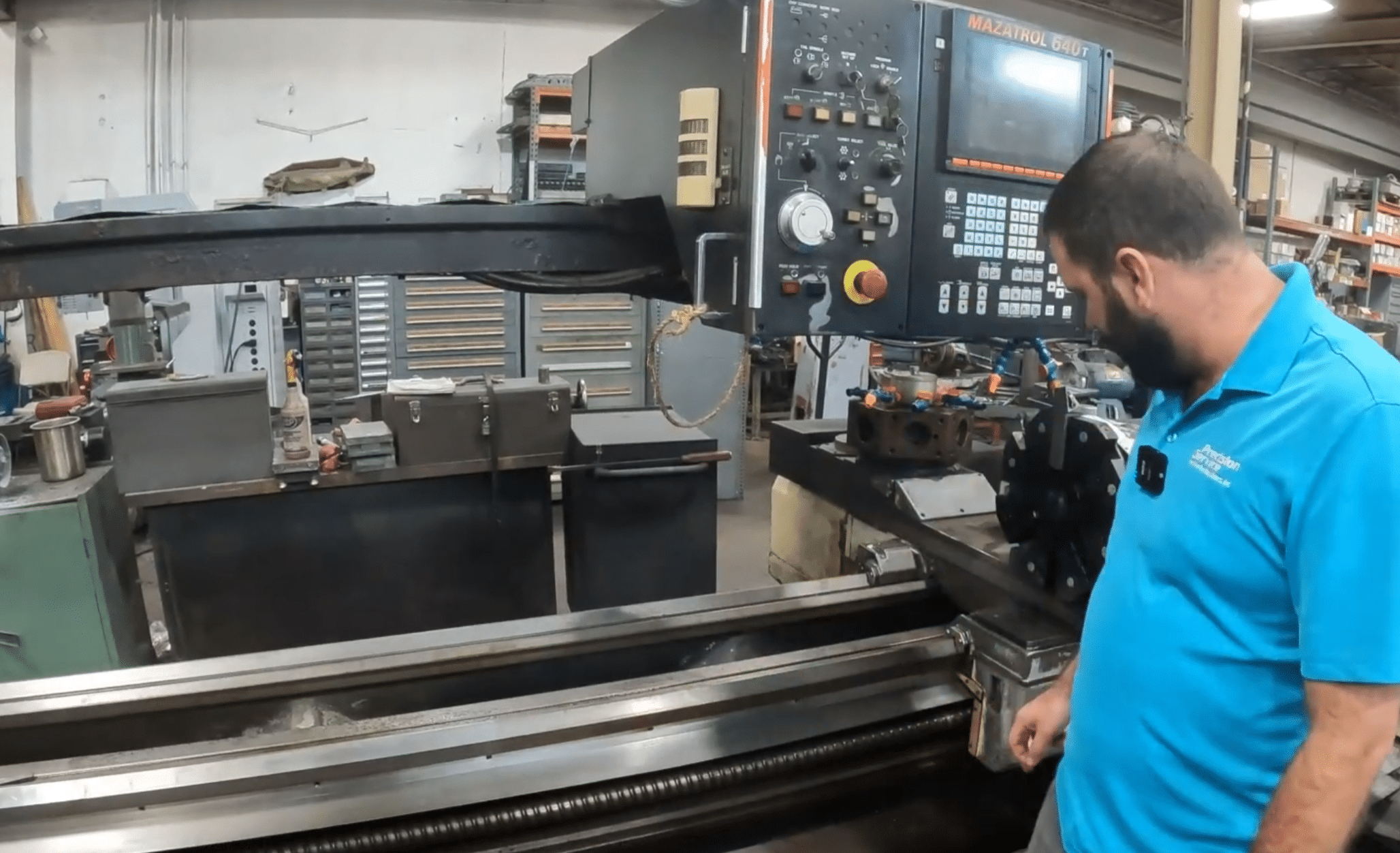
A heavy-duty production shop relied on Precision Service Machine Tool Rebuilders (PSMTR) to perform a comprehensive restoration of a large-capacity power-turning platform designed for long-shaft, high-torque machining. After decades of continuous service, the machine exhibited severe wear in its spindle system, saddle ways, headstock structure, lubrication network, and overall geometric alignment. Accuracy drift, vibration, and degraded surface finish were beginning to limit throughput and reliability.
Rather than purchase a new machine—an investment that would have required substantial capital and long manufacturer lead times—the customer selected a complete mechanical and geometric rebuild. PSMTR executed the entire project including teardown, way grinding, spindle and gearbox reconditioning, hydraulic and lubrication overhaul, full alignment, and performance testing. The machine was returned to production with near-new accuracy, improved rigidity, and a significantly extended service life.
Project Background & Objectives
The customer operated a large power-turning machine used for machining long shafts, rolls, and heavy cylindrical components under high torque. Over years of demanding operation, the machine experienced:
With new machines of this size commanding high capital expense and multi-month delivery windows, a rebuild offered a clear set of objectives:
PSMTR’s long history with large-format turning equipment made them the ideal partner for this complex restoration.
Our Rebuild Process
- Full Disassembly, Mapping & Condition Evaluation
- Cleaning & Preparation
- Way Grinding & Geometry Correction
- Hand Scraping for Precision Fit, Contact & Oil Retention
- Headstock, Spindle & Geartrain Reconditioning
- Lubrication & Hydraulic System Restoration
- Reassembly, Alignment & Performance Verification
PSMTR began with a complete teardown of the machine:
- Removal of the headstock, gearbox, saddle, cross-slide, and ancillary assemblies
- Mapping of geometric errors across bed, saddle, and centerline relationships
- Inspection of spindle bearings, drive gears, clutches, and shift mechanisms
- Evaluation of lubrication channels, feed tubes, and oil distribution passages
- Analysis of structural integrity and wear within cast-iron housings
The thorough inspection defined the mechanical and geometric work required to return the machine to stable accuracy.
Before precision work began, all components underwent:
- Intensive degreasing and contaminant removal
- Cleaning of ports, oil galleries, and supply passages
- Rust removal from unused contact surfaces
- Preparation for precision fixturing and metrology setups
This ensured that all subsequent machining and scraping was performed on fully prepared components.
The machine bed and saddle ways had accumulated measurable wear. PSMTR employed their large-capacity way grinders to restore:
- Straightness and parallelism of the bedways
- Correct relationship between machine centers
- True mating geometry between saddle and bed surfaces
- Removal of wear channels, step wear, and low-spot areas
This step re-established the foundation required for long-travel precision.
After grinding restored the major geometry, PSMTR applied extensive hand scraping to refine:
- Bearing contact percentage across saddle and cross-slide surfaces
- Uniform load distribution under heavy cutting forces
- Oil-retention patterns needed to maintain hydrodynamic film
- Smooth, uniform travel without binding or drift
This handwork is critical on large power-turning equipment where even minor contact imbalances can lead to chatter and accelerated wear.
The power-turning headstock required a full reconditioning, which included:
- Replacement of spindle bearings and thrust bearings
- Inspection and rework of drive gears, shift mechanisms, and clutches
- Reconditioning of internal shafts and bores
- Verification of spindle concentricity and rigidity under load
- Re-establishment of proper lubrication flow to critical rotating elements
The restored headstock delivered renewed stability, torque transfer efficiency, and cutting consistency.
The machine’s lubrication system was a major contributor to its degradation. PSMTR performed:
- Complete rebuild of lubrication pumps, manifolds, and flow lines
- Cleaning, re-cutting, or enlarging of oil pockets and galleries
- Removal of contamination and old sludge
- Restoration of even distribution across all bearing surfaces
- Re-establishment of hydraulic feed and load-control functions
This returned the machine to proper thermal behavior and significantly reduced future wear.
With mechanical systems restored, PSMTR reassembled and aligned the machine:
- Realignment of the headstock to the bed centerline
- Carriage and cross-slide movement verification through full travel
- Backlash minimization across feed systems
- Load testing to identify vibration or positional anomalies
- Final cutting tests to confirm finish quality and repeatability
The machine demonstrated smooth travel, restored spindle accuracy, and stable performance under heavy cutting loads.
Value Delivered by PSMTR
Conclusion
This rebuild demonstrates how a full mechanical and geometric restoration can return a heavily worn power-turning system to high-accuracy, reliable performance—without the enormous cost or downtime associated with new equipment procurement.
For shops experiencing vibration, geometric drift, poor finishes, lubrication issues, or declining spindle performance on large turning machinery, a professional rebuild offers outstanding ROI, long-term reliability, and renewed production confidence.
Disclaimer
This case study is provided for informational purposes only. Every machine, application, and operating environment is unique. Actual results may vary. Always consult qualified professionals before making decisions regarding equipment repair, rebuild, or replacement. To learn more about this project, view a breakdown on our YouTube Channel.