
Overview
A manufacturing customer brought their TRAK DPM7 bed mill to Precision Service Machine Tool Rebuilders after experiencing accuracy drift, uneven table travel, and wear across the knee, saddle, and table ways. Rather than replace the mill or accept ongoing performance loss, the customer sought a full mechanical rebuild with expert hand scraping to restore geometric integrity.
PSMTR performed a complete tear-down, component evaluation, precision grinding, and extensive scraping of the saddle-to-knee and table-to-saddle interfaces. The process restored bearing geometry, corrected wear from years of production use, re-established proper contact percentage, and delivered smoother, more consistent movement throughout the machine’s operating envelope. The rebuilt mill returned to the customer operating at near-factory performance — with improved alignment, better load distribution, and extended usable life.
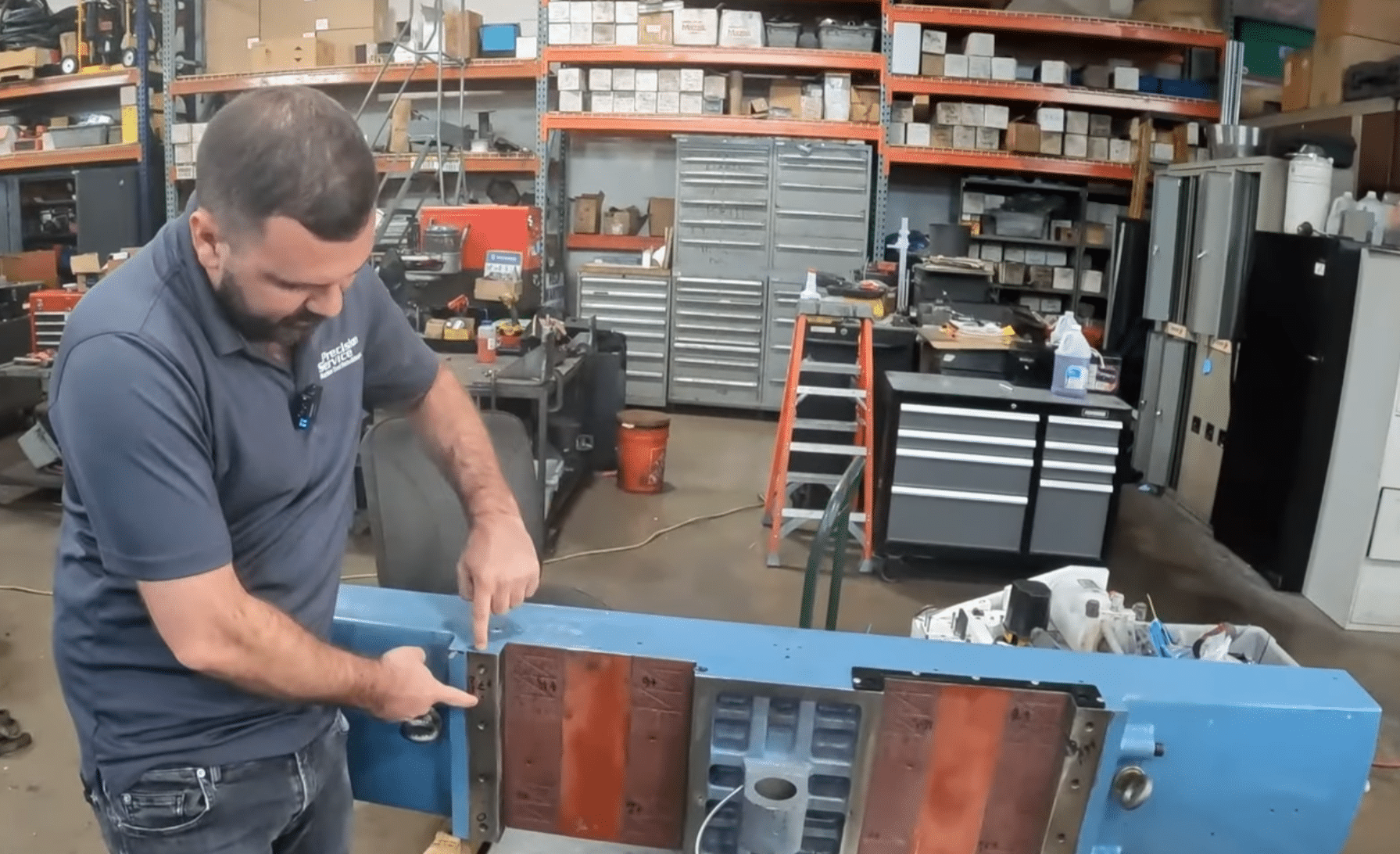
Project Background & Objectives
The TRAK DPM7 is a heavy-duty, turret-style bed mill used for tooling, repair parts, prototype work, and general machining. The customer’s machine exhibited several symptoms common to long-running mills:
Replacing the machine would have required significant investment and downtime. Instead, the customer requested a rebuild focused on:
PSMTR was selected due to extensive expertise in rebuilding large knee mills and their proven capabilities in high-accuracy hand scraping.
Rebuild Process
- Full Machine Disassembly & Initial Condition Assessment
- Cleaning, Degreasing & Surface Preparation
- Precision Grinding of Mating Surfaces
- Extensive Hand Scraping for Geometry, Contact & Oil Retention
- Gib Fitting, Lubrication Restoration & System Checks
- Final Assembly, Alignment & Verification
The process began by removing the table, saddle, and associated hardware to expose the primary bearing interfaces. Key assessment tasks included:
- inspecting the saddle and knee ways for wear, scoring, and hollow spots
- checking table ways for uneven wear and geometric drift
- measuring twist, bow, and flatness deviations along sliding surfaces
- evaluating lubrication passages and oil distribution points
- checking gibs for wear or distortion
- documenting the bearing-pattern irregularities requiring scraping correction
This stage produced a complete roadmap of the geometry that needed to be restored.
Before machining or scraping could begin, PSMTR completed:
- removal of accumulated chips, sludge, and dried lubrication
- degreasing all way surfaces, cavities, and threaded ports
- cleaning internal oil channels and metering points
- preparing components for fixturing and metrology
Proper preparation ensured reliable accuracy throughout the rebuild.
To restore a true foundation before scraping, PSMTR performed controlled grinding on worn surfaces where material loss required correction. This included:
- re-establishing flat, even way geometry on the saddle and table
- removing low spots, steps, and wear ridges
- restoring parallel surfaces to factory-spec relationships
- preparing surfaces for final hand scraping
Grinding provided a consistent geometric baseline for the precision scraping stages.
Hand scraping represented the core of this rebuild. PSMTR executed a multi-stage scraping process across all sliding interfaces:
- Saddle-to-knee scraping to correct wear patterns and restore rigid, stable movement
- Table-to-saddle scraping to achieve uniform bearing across the full travel
- Establishing proper bearing-contact percentage, improving both load distribution and vibration damping
- Developing oil-retention pockets and cross-hatch patterns to support consistent lubrication
- Ensuring straight, predictable movement at every point of travel
This handcrafted process delivered the precision necessary for a mill expected to perform accurately for years beyond its original wear life.
After the major geometry work, PSMTR completed:
- refitting, scraping, or replacing gibs to ensure proper preload
- clearing and restoring lubrication channels
- verifying steady oil distribution across all bearing surfaces
- checking smoothness and force consistency through travel
Reliable lubrication is critical for maintaining the freshly scraped geometry.
Once major components were rebuilt, the team:
- reassembled the saddle, table, and knee
- aligned the machine in both X and Y axes
- checked movement uniformity across full travel
- tested for tight spots, rocking, or binding
- performed geometric checks to confirm restored accuracy
The finished machine demonstrated smooth, stable travel with geometry comparable to a near-new mill.
Value Delivered by PSMTR
Conclusion
The TRAK DPM7 rebuild demonstrates the effectiveness of precision scraping and geometry restoration in returning a worn bed mill to dependable, near-factory performance. Through expert disassembly, surface correction, and meticulous hand scraping, PSMTR delivered a machine with renewed accuracy, improved lubrication performance, and extended service life.
For operators experiencing wear-related accuracy loss, inconsistent table movement, or lubrication problems, a professionally executed rebuild offers exceptional return on investment and keeps critical equipment operating reliably without the cost and disruptions of a replacement machine.
Disclaimer
This case study is provided for informational purposes only. Every machine’s condition and operating environment is unique. Actual results may vary. Always consult qualified professionals before making equipment decisions.
To learn more about this project, view a breakdown on our YouTube Channel.